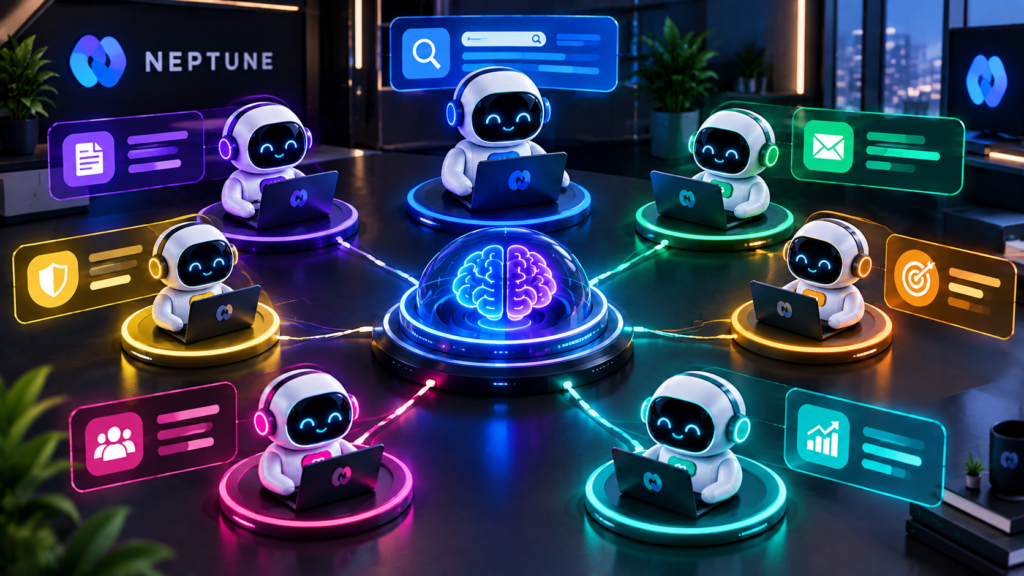
Artificial intelligence is moving beyond the idea of one model doing everything. A Multi Agent System in AI uses several specialized AI agents that work together to complete tasks, much like a team where every member has a different responsibility. One agent may research information, another may analyze it, while a third creates the final output.
What Is a Multi Agent System in AI?
A Multi Agent System (MAS) is an AI setup where multiple autonomous agents interact with one another and their environment to achieve a shared goal.
Instead of asking one AI agent to handle every part of a complicated task, the workload is divided among agents with different roles and capabilities. Think of it as a digital team. Each agent has its own instructions, tools, knowledge, and responsibilities, but all agents contribute toward the same outcome.
How Does a Multi Agent System Work?
The basic process of a Multi Agent System in AI starts with a larger goal. The system breaks that goal into smaller tasks and assigns them to suitable agents. These agents then perform their individual jobs, exchange information, review results, and pass useful outputs to other agents.
The workflow can continue until the overall task is completed. This makes multi-agent workflows particularly useful when a problem has several moving parts that need to work together.
Specialized AI Agents
Specialization is one of the main ideas behind multi-agent AI. For example, a research agent can focus on gathering information, a coding agent can work on software, and a review agent can check the result.
Giving each agent a clear role can reduce the amount of context one agent has to manage at once. It also allows each agent to focus on what it does best.
Communication and Coordination
Agents need a way to communicate. Depending on the system, they may exchange messages, share data, pass completed tasks to one another, or work through a central coordinator.
Good coordination keeps agents from repeating the same work and helps the system move from one stage to the next. This is where AI Agent Orchestration becomes important because it helps manage how different agents and tasks interact.
Task Distribution and Execution
Once the main objective is understood, tasks can be distributed according to each agent’s capabilities. A coordinator might decide which agent should research, which should analyze, and which should produce the final response.
Agents then execute their assigned tasks and return their results to the workflow. The system can combine these outputs to complete the larger objective.
Multi Agent System Architecture
The architecture describes how agents, tools, data, and communication channels are connected. A simple system might have one coordinator directing several specialized agents, while a more decentralized design allows agents to communicate directly.
The right structure depends on the complexity, control requirements, and goals of the application.
Centralized Architecture
In a centralized architecture, one main agent or orchestration layer manages the workflow. It can assign tasks, monitor progress, collect results, and decide what happens next.
This structure can be easier to control because there is a clear decision-making point. It can also make monitoring the overall workflow more straightforward.
Decentralized Architecture
A decentralized system gives agents more independence. Agents can communicate and make decisions without relying on one central controller for every step.
This approach can support flexible workflows, although it also makes coordination, monitoring, and error handling more challenging.
Key Benefits of Multi Agent Systems
Multi-agent systems can divide complex work into manageable pieces. They can also allow different agents to use specialized tools and approaches.
Another advantage is flexibility. A new agent can sometimes be added for a specific capability without redesigning the entire workflow.
For organizations, this approach can be useful for automating processes that involve research, reasoning, writing, analysis, software development, or other tasks that require multiple capabilities.
Multi Agent System Examples
Multi-agent AI can be applied across many areas. The important idea is not simply using several agents, but giving each one a meaningful role within a coordinated workflow.
Customer Support
A customer-support system could use one agent to understand a customer’s request, another to search a knowledge base, and another to prepare or review the response.
A coordinator can then combine their work before the answer reaches the customer. This creates a workflow where each agent handles a specific part of the customer interaction.
Software Development
In software development, separate agents could handle requirements analysis, coding, testing, documentation, and code review.
Instead of one agent attempting every step, each agent focuses on a defined part of the development process. Their outputs can then be passed between agents to move the project forward.
Research and Data Analysis
A research workflow could include agents for information gathering, data analysis, fact checking, summarization, and report writing.
The agents can pass their findings through the workflow until a complete report is produced. This can be especially useful for tasks that require several stages of research and analysis.
Multi Agent Systems vs Single-Agent Systems
A single-agent system generally relies on one AI agent to interpret a task, reason through it, use tools, and produce an answer.
A multi-agent system divides those responsibilities among multiple agents. One agent might research while another analyzes the information and another reviews the final result.
Simple requests may not need several agents, while complex workflows with distinct stages can benefit from specialization and coordination.
Challenges of Multi Agent Systems
Multi-agent systems also introduce new challenges. Communication between agents can increase complexity, and poor coordination may lead to duplicated work or inconsistent results.
More agents can also mean additional infrastructure, monitoring, and operational costs. Developers therefore need to define clear roles, communication rules, permissions, and evaluation methods before deploying a multi-agent workflow.
Reliable monitoring is also important because a problem with one agent can sometimes affect the rest of the workflow.
Conclusion
A Multi Agent System in AI brings the idea of teamwork into artificial intelligence. Instead of relying on one agent for every responsibility, multiple specialized agents can collaborate on different parts of a larger problem.
From customer support and software development to research and data analysis, this architecture can support workflows that require several capabilities working together.
The key is thoughtful design: clear roles, reliable communication, effective orchestration, and proper monitoring. When these elements work together, multiple AI agents can turn complex tasks into a structured and manageable workflow.
Frequently Asked Questions
What is a Multi Agent System in AI?
A Multi Agent System is an AI architecture where multiple autonomous agents interact and collaborate to achieve a shared objective.
How does a multi-agent system work?
It divides a larger task into smaller responsibilities and assigns those responsibilities to specialized agents that communicate and coordinate their work.
What is an example of a multi-agent system?
A software development workflow could use separate agents for coding, testing, documentation, and code review.
What is multi-agent system architecture?
It is the structure that defines how agents, tools, data, communication, and orchestration components interact within the system.
What is AI Agent Orchestration?
AI Agent Orchestration refers to coordinating agents, tasks, tools, and workflows so that multiple AI agents can work together toward a common result.